
 Traditionally, you’ve been far more likely to find Chrome OS powering a PC-like device than Android. That’s even been true for all-in-one devices, where even Chrome OS has been a rarity. But for those who want something that’s like an Android tablet experience that stays put and is always plugged in, AliExpress offers a 10″ 1280×800 Android 13 touchscreen device that includes two USB-A ports, HDMI out, Ethernet and a microSD slot in white or black finishes for a bit under $170 in a configuration that includes 2 GB of RAM and 16 GB of flash. Bumping the specs to 4 GB of RAM, 32 GB of flash, and Android 14 brings the price to almost $210. There’s also an option that includes the display in a portrait orientation. The devices are marketed as being for signage and kiosks, but could likely serve as a basic general computer.
Hands-On: Atari Gamestation Go

Pros
✔️Large screen, HDMI out, and range of context-sensitive control. Can optimize games for 4:3 or 16:9 optimization. Can load ROMs for many classic systems via microSD card
Cons
✖️Small selection of Atari 5200 and 7800 games. No button-mapping for user-added ROMs
Score: 9️⃣ (out of 10)
Once, the Flashback consoles provided just about the only way to relive the early days of Atari videogaming. Lately, however, in addition to a range of mini remakes like the Atari 7800+ (now available in a Pac Man edition) the market has been saturated with a range of products that provide retro experiences on the go. Most of these, though, have had smaller displays and have been sold with unlicensed game files. Previous sanctioned Atari handhelds have included AtGames’ nearly decade-old Flashback Portable (with a 2.8″ display and bundled with up to 80 games) and My Arcade’s Pocket Player Pro (with a 2.75″ display and bundled with 100 games).
MagTran M3 brings clarity to the macro keypad
 Back in 2023, an Australian team created a Kickstarter campaign for the radically customizable Flux keyboard. While they’re heading toward the finish line, a less ambitious project has tackled taking a similar approach to a Steam Deck-style macro keypad. Embedding a full display below the buttons allows the use of photos or video loops below the button labels. You can even show a spectrograph under music controls or play mini-games. Since one reason the Stream Deck stays ahead of the pack is its application support. the VSD team has created a cloud platform called Space; the creators say the M3 should be compatible with 500 plugins, more than 300 scenes, over 200 icon packs, and over 100 dynamic backgrounds at launch as it promotes an open developer ecosystem.
Kensington’s Expert Mouse TB800 EQ: This is how style rolls
 Trackballs: they’re not just the throwback input device on the Macrodata Refinement terminals particularly featured in the last episode of Severance Season 2. They’re a stable and mature mouse alternative for desktops that require minimal movement. Kensington, which pioneered the large-ball variety in 1989, may have reached its pinnacle of design with its new Expert Mouse TB800 EQ. The low-profile device features a pair of side rollers alongside a dial at the foot of the ball and a host of crowning buttons atop the design’s typical four. With that many controls, it’s worthy of consideration as a true media controller in addition to being Kensington’s best-looking trackball since its SlimBlade Trackball .
Retro Games goes full-size 32-bit with the A1200
 Retro Games, Ltd. has won fans for its miniature recreations of classic computers like the Commodore 64, Atari 400, and Amiga 500. But the usable keyboards on its larger recreations of the Commodore 64/VIC-20 and ZX Spectrum have provided a more authentic retro experience. Now, the company has revealed plans for a full-sized Amiga recreation, the A1200, complete with a numeric keypad, gamepad, and mouse. Preorders should begin in November, but the products aren’t expected to ship until next June.
Intellivision Sprint updates Atari’s rival with wireless controllers, HDMI and USB expansion
 When many of the game consoles (and a few of the computers) of yesteryear were being reintroduced as plug-and-play “mini” versions loaded up with a selection of games, AtGames took a break from repeated reintroductions of its Atari 2600 “Flashback” series to create homages to two of that console’s competitors, the Intellivision Flashback and ColecoVision,Flashback, both preloaded with 60 games (plus one bonus in a store-exclusive version).
Now that Atari has the rights to the Intellivision brand, hardware design and original game library, it’s creating a modern incarnation of the original Intellivision dubbed the Intellivision Sprint with a few improvements, which include wireless, rechargeable controllers and HDMI video. The product has been designed by Retro Games, which has earned high marks for both mini and full-size recreations of the Commodore 64 and other retro gaming platforms, and for its use of USB ports for adding additional games. Alas, as with Retro Games’ TheC64 and upcoming The1200, there’s no cartridge slot for playing the original physical games and homebrews. However, a USB connector will allow taking the digital selections far beyond the 45 games (for Intelivision’s 45th anniversary) that come included with the retro console.
Alas, there haven’t been any modern recreations of the ColecoVision on the horizon since the FGPA-based CollectorVision Phoenix, available only through eBay. The company has said it’s not planning another production run or sequel.
WowCube takes another turn with Rubik’s branding
 From its preorder campaign in 2022, the WOWCube was one of the most inventive electronic games we’d seen in a while. The straightforward: What if we took the dynamics of Rubik’s Cube and made each square a miniature touchscreen. (It’s a 2×2 vs. 3×3 grid because the latter proved prohibitively expensive.) The company lined up a couple of strong retro and casual game licenses in Space Invaders and Cut the Rope and threw in a few widgets to provide utility even when it was charging on its dock. Then came an extended gestation before the products shipped last year. Cubios used some of that time, though, to design a successor. The cube is back with a smoother motion, more durable build and displays, and a Rubik’s license, which the company says raised the bar in terms of the expected experience. The new version is expected to ship this holiday season.
The Commodore 64 Ultimate gets the ultimate GUI of 1982
 There have been no shortage of Commodore 64 revivals big and small. This fall, though, fans of the pioneering computer will get an official reboot from its new owner. While games have been the primary application behind modern recreations of classic computers, followed by a renewed exploration of BASIC, those computers also had their share of productivity applications. And some of those early applications ran in an early graphical interface called GEOS. Now, Commodore, Inc. has noted that GEOS will be included with all flavors of the Commodore 64 Ultimate, making it easier for those familiar with modern GUIs to find their ways around and making more of a distinction between consoles and true home computers with great game libraries.
Qi 2’s speed boost could mean an adoption boost
 When it comes to iOS versus Android, adoption of the Qi wireless charging standards has been a seesaw. Apple held out on Qi and then incorporated support for it in its MagSafe charging standard that added magnetic stability to the charging connection. Then MagSafe formed much of the basis for Qi2, but Android vendors have all but avoided supporting the new standard.
Meanwhile, while they have skipped on the magnetic attachment, Chinese phone vendors like OnePlus have pushed the envelope on high-wattage wireless (and wired) phone charging.
The next chapter in the saga brings many of these elements together with a 25-watt version of Qi2 (previous versions were limited to 15 watts). The speed bump was contributed to the standard by Google so there’s a good chance we will see it supported in the next round of Pixel phones.
4URPC provides a dash of display
 USB-C and Thunderbolt docks are taking on all kinds of functionality beyond port replication, from support for Intel’s Thunderbolt Share peer-to-peer file and screen-sharing tech to becoming app platforms.
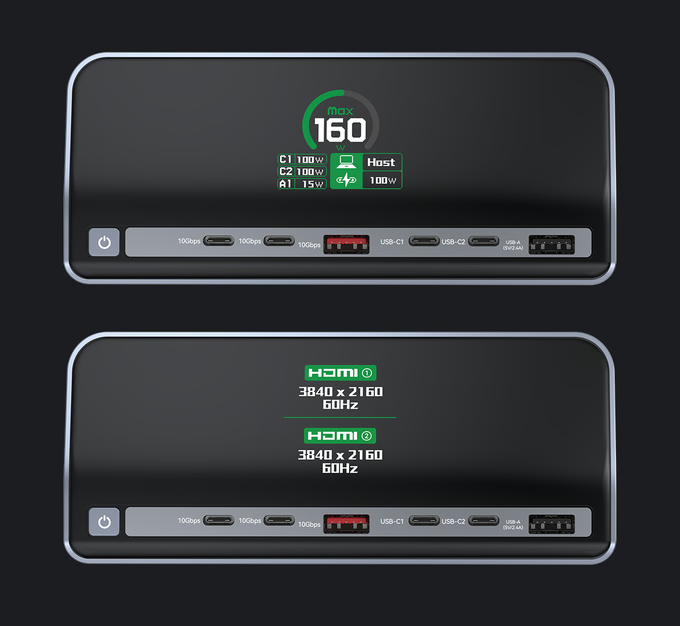
A 160-watt dock branded 4URPC (can’t argue with that) making its way through Kickstarter strikes a middle ground, showing basic info on the power levels being used and the resolutions being supported. While it stays true to the kind of info that’s relevant to its tasks, it’s not info that should change very often.